Friday, 12 March 2010

Jupiter and Mercury, hiding behind the Sun!

If you are wondering where Jupiter and Mercury are at the moment... they are hiding behind the Sun!

Below is a movie using data from the Lasco C3 insrtument on the NASA/ESA SOHO observatory, during February 2010. SOHO points constantly at the Sun, and so it allows us the see Venus, Jupiter and Mercury following their orbits around the far-side of the Sun.

It begins with Venus leaving the scene towards the left (which is why we can see it now in the evening sky), and then Jupiter moving left to right, and finally Mercury appearing!

Note that Lasco C3 is sensitive to 540nm-640nm wavebands, which is mid-green through to mid-red... so I've changed the usual blue colour to grey-scale (I think true colour would be a yellowish-brown...?).

Note also the 'bleeding' of the bright planets - they are so bright, that electrons over-flow into neighbouring cells on the Lasco-C3 CCDs. Note the the Sun is hidden behind a disk, to ensure that its brightness does not damage the camera.
Monday, 8 March 2010

Venus is back!

In January, Venus was on the far side of the Sun and totally hidden in the glare of the Sun.

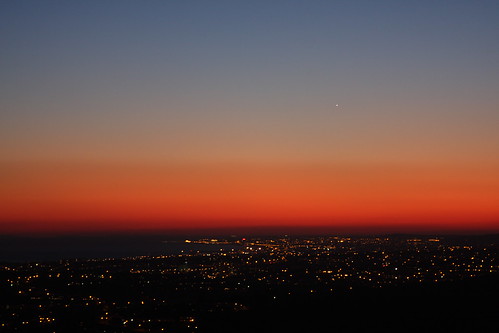
But now it is back! Take a look in the evening sky for a glimpse of the brightest planet...

IMG_2478

Venus will be a prominent member of the night sky throughout the summer until the end of August. If you have a zoom lens on your camera you may be able to just make out the crescent of this planet, which is very obvious with even a small telescope. Our view of Venus' crescent will change over the next few months, as it orbits the Sun. The animation below shows this in more detail.

Venus began 2010 on the opposite side of the solar system to the Earth, which is why we could not see it. By March 2010 (when the Earth is at the 11 O'clock position in this animation), Venus became visible in the evening sky.

By 20 August 2010, Venus will reach its maximum Eastern position from the Sun (when the Earth is at the 5 O'clock position on this animation). And then Venus rapidly "catches up" with the Earth, being between the Earth and the Sun on the 29th October, 2010.

The animation then returns to the beginning of the year to watch how the phase of Venus (what fraction of Venus is illuminated) changes during 2010.

But by October, when Venus is between us and the Sun, we will only be able to see the night-time side of Venus. (Venus will also appear to get larger in size during the course of the year).

International Space Station

To see a satellite, it must fly over head at either dawn or dusk - when it is dark enough for us to see them, but when sunlight can still shine onto the satellite (for instance, if a satellite flies over-head at midnight, it is in the shadow of the Earth for the entire flyby).

Sometimes, a particular satellite will fly over-head at midday when the daylight is too bright; sometimes it might fly over at midnight when it cannot reflect sunlight.

You might have seen satellites flying over-head yourself and just not realised what you are looking at. The rule of thumb is - if it is flashing, it is an aircraft, but if it is at a steady brightness, then you are looking at a satellite!


For the next week, the International Space Station is ideally placed to be seen flying directly over the UK! The approximate dates and times are listed below...


DateTime, direction (and altitude) of...
AppearanceHighest pointDisappearance
8 March19:26
West (10°)
19:29
South (73°)
19:30
East (52°)
9 March18:16
South-West (10°)
18:19
South (42°)
18:22
East (10°)
9 March19:51
West (10°)
19:54
West (70°)
19:54
West (70°)
10 March18:41
West (10°)
18:44
South (75°)
18:46
East (13°)
11 March19:06
West (10°)
19:09
North (85°)
19:11
East (23°)
12 March19:31
West (10°)
19:34
North-West (89°)
19:34
East (47°)
13 March18:20
West (10°)
18:23
North (85°)
18:26
East (10°)
13 March19:55
West (10°)
19:58
South-West (61°)
19:58
South-West (61°)
14 March18:45
West (10°)
18:48
South (89°)
18:51
East (12°)
15 March19:10
West (10°)
19:13
South (61°)
19:15
East (20°)
16 March19:35
West (10°)
19:37
South (32°)
19:39
South (24°)
17 March18:24
West (10°)
18:27
South (59°)
18:30
east (10°)

For other times and locations, see the SpaceWeather flyby predictor.

Saturday, 6 March 2010

The Night Sky for March, 2010

March is one of the best times of the year for astronomy, simply because there is so much to see!

Orion and Taurus – along with all the amazing objects that surround that part of the sky, such as Orion's nebula, Betelgeuse, the Pleiades - are visible in the evening, and as they set by midnight, the summer highlights begin to rise in the east – Hercules, the Great Globular cluster, with Vega and the rest of the summer triangle on their way from the morning sky into the evening sky, signalling that summer is not far away.

We can see both Mars and Saturn throughout the night, with the latter rising at sunset. The Moon glides under Mars on the 25th March, and then passes under Saturn a few days later on the 29th. Both Mars and Saturn are quite bright, so they are easy to spot.

For more details, I recommend you use the free planetarium software Stellarium – you can download it for Macs, Windows or Linux.