Thursday, 10 December 2009

XMM-Newton: 10 years old today!

The XMM-Newton space telescope is celebrating its 10th anniversary in space!

Although there is a huge amount of British involvement in XMM-Newton, it truly is an international mission. In brief...

  • Two out of three X-ray camera's were built (and are maintained) in the UK (pictured above-left);
  • The optical/UV telescope was built in the UK;
  • One X-ray camera was built in Germany;
  • Two spectrometers (the RGS) were built in the Netherlands and the USA;
  • All three X-ray mirror modules were built in Italy;
  • Data analysis software and data storage by the UK & USA;
  • The spacecraft was assembled in the Netherlands;
  • Continuous XMM-Newton support is based in Spain, with support from the UK, Germany, France, Italy, Netherlands, and the USA;
  • The radiation monitors were built in France;

XMM-Newton has made some amazing discoveries about the high-energy Universe in that decade. Lots of images from those XMM-Newton discoveries can be found online at the XMM-Newton image gallery, and a slideshow is available on the BBC News online website, narrated by myself (Dr Darren Baskill) and my colleague Dr Kathy Romer here at the University of Sussex's Department of Physics & Astronomy.

Geminid meteor shower peaks

We are currently travelling through dust left behind by an asteroid called 3200 Phaethon, which we think is an extinct comet. As the Earth travels through space at an astonishing 70,000 mph, these bits of dust hit the atmosphere causing "shooting stars" as the dust burns up.

You can see these shooting stars throughout mid-December, but the main peak is from the 12th to the 14th of December where you could see up to two a minute under ideal conditions.

It is (unfortunately!) best to see shooting stars in the early morning, a few hours before sunrise, since that is when we are stood on the "front" of the Earth as it orbits around the Sun. It's a bit like driving through snow - it looks best looking forward where you see all the snow rushing towards you, and it's not so exciting when you look out of the back window.

Thursday, 3 December 2009

LHC talk at Sussex

Institute of Physics

South Central Branch - Brighton area - presents

Particle physics
and the Large Hadron Collider

Speaker: Dr David Newbold, University of Bristol
Date: Tuesday 8 December
Time: 19h00
Location: University of Sussex, Pevensey 1 building, room 1A7

The Large Hadron Collider is the world’s biggest scientific instrument. After twenty years of design and construction, collisions will start within the next few weeks, the first step on a new voyage of discovery into the world of the incredibly small.

Dr Dave Newbold will explain why particle physics appears complex, but is actually simple — but how building the accelerator and experiments has been more challenging than you might think. He’ll take a look at how the LHC works, see how the experiments are carried out, and talk about some of the new discoveries that could be made in the coming years.

Wednesday, 2 December 2009

December's Night Sky

This is the month to take advantage of, and enjoy, the long nights!

The earliest sunset here in Sussex occurs at 15:54 on the 12th of December, and the shortest day is on the 21st this year. The Earth is tilted, and the shortest day occurs when that side of the Earth is tilted directly away from the Sun - and so the solstice actually occurs at a specific moment in time, at 17:46 on the 21st December, 2009.

The increasingly inaccurately named summer-triangle is still visible, low in the west, but only until 7.30pm - ideal for after-school observing events! And the Andromeda galaxy is still well placed in the evening sky (see last months posting for full details about both of those).

CRW_3625

Jupiter is still a wonderful sight until about 8pm throughout the month - just look for the brightest object you can find, low in the west, and that will be Jupiter! Look through binoculars or a small telescope to see four of the 60 moons that orbit this gas giant.

The 21st of December is a great day for a photo' opportunity. That late afternoon and early evening, the planet Jupiter is visible just below the Moon. And just to the top-right of Jupiter, is the planet Neptune - although you will need a telescope to see Neptune, as it is 10,000 times fainter than Jupiter!

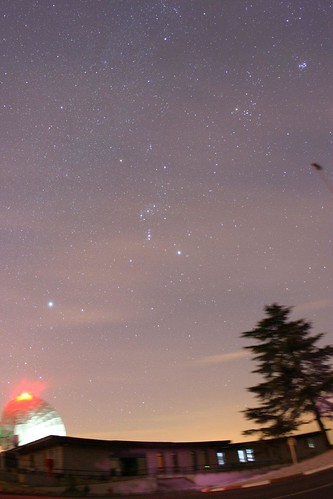
Rising at 8pm in the east is the constellation of Orion - a very familiar sight in the winter skies, thanks to the three stars that form a straight line, and which are known as Orion's belt (as in the photo to the left). Just below those three stars in a line, are another group of three stars in a line... only, the middle star is not a star at all, but a huge gas cloud where stars are in the process of forming. You can see it with your own eyes, but look through a telescope and you can see much more detail, and take a long exposure photo', and you can see even more detail! The movie below shows the difference between looking through a telescope yourself, and taking a 15 minute long exposure photograph.

You can get some very easy-to-use and clear star maps from either Skymaps.com, or by using the excellent (and free) Stellarium Planetarium software.